
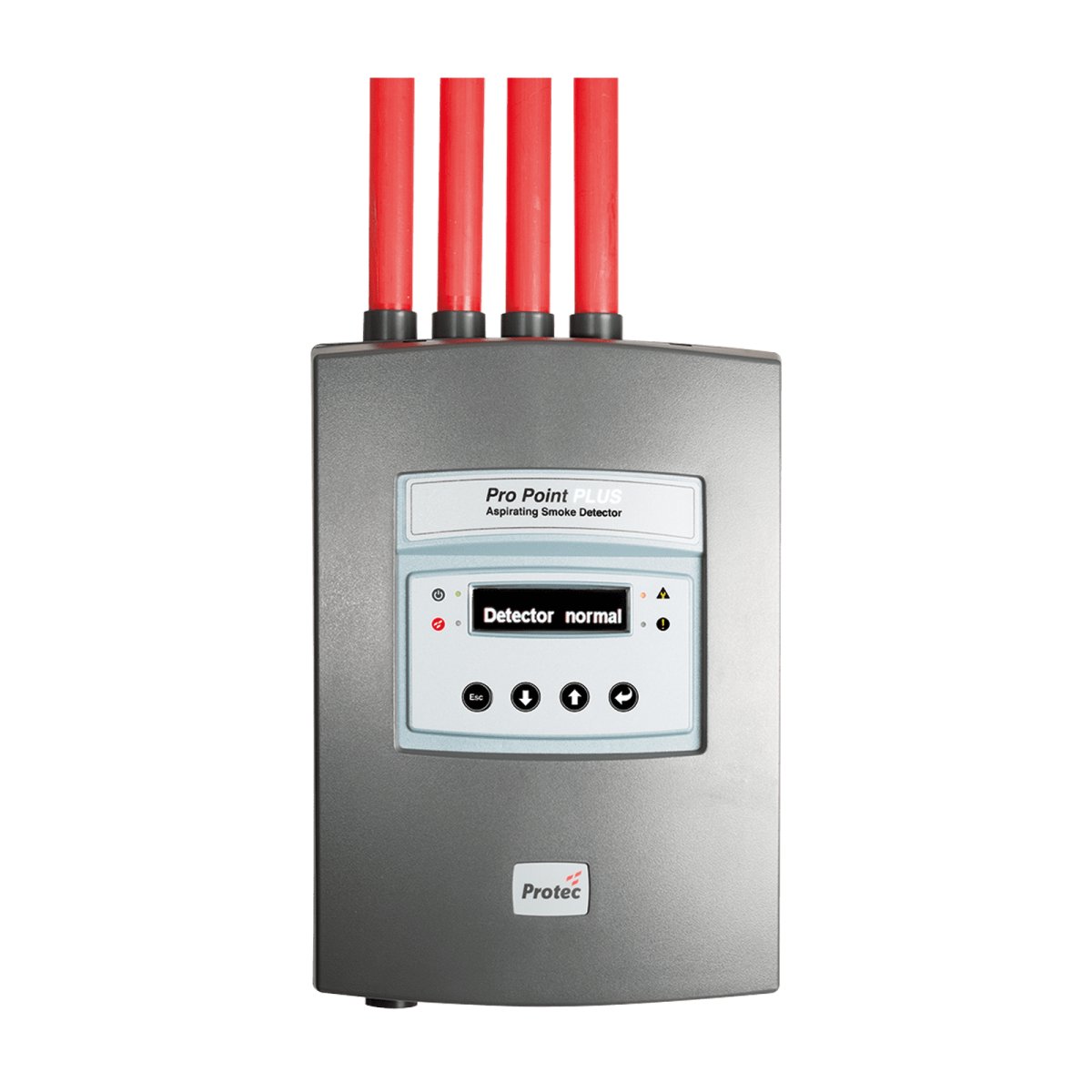
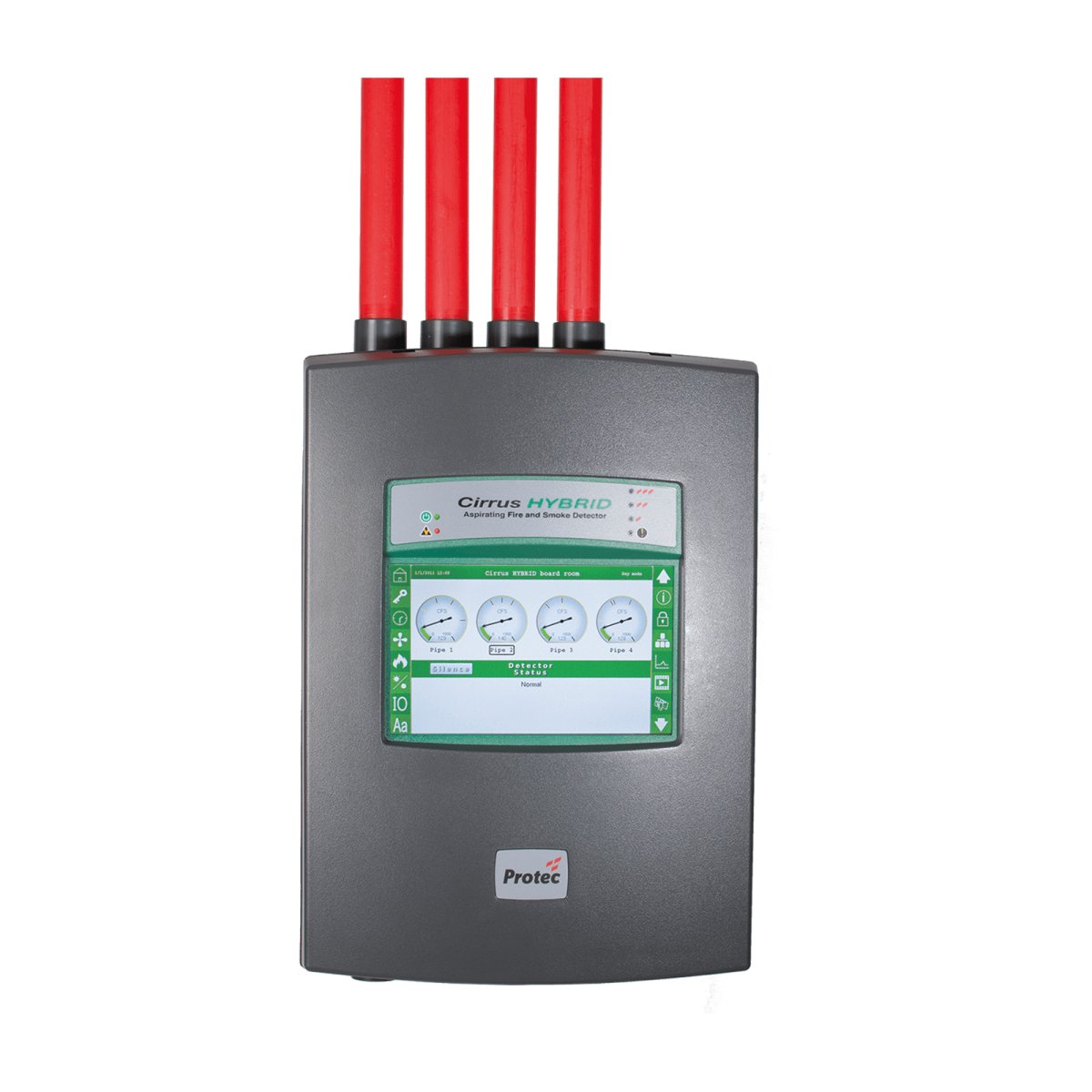
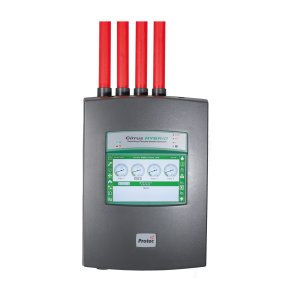
High-Sensitivity Intelligent Addressable Aspirating Smoke Detector (ASD) An enterprise-grade, laser-based early warning fire detection system designed to actively draw continuous air samples from a protected zone through a network of engineered sampling pipes. Featuring a high-efficiency internal aspirator fan, multi-stage filtration, and a high-purity laser detection chamber, this system identifies trace smoke particles at a molecular level up to 1,000 times more sensitively than standard point smoke detectors, intercepting fires during the pre-combustion smoldering stage.
Laser-Based Active Air Sampling for Critical Infrastructure Protection
In mission-critical installations—such as data center server vaults, telecommunication clean rooms, cold-storage automated warehouses, and high-ceiling atriums—passive fire detection is an unacceptable risk. Standard spot smoke detectors are entirely passive; they rely on the thermal energy of an active fire to physically push smoke up to the ceiling and drift inside the detector chamber. In a clean room with high-velocity floor-ducted cooling fans, or in a 20-meter-high atrium, smoke is rapidly diluted, chilled, or diverted by intense air currents, bypassing standard sensors entirely. An Aspirating Smoke Detector (ASD) counters this by turning fire detection into an active, forced process.
Instead of sitting on the ceiling waiting for smoke to rise, the main ASD processor unit is mounted at an accessible wall height. It connects directly to a custom-engineered network of CPVC pipe runs extending across the ceiling or inside floor plenums. The pipes feature a series of precise, laser-drilled sampling holes that act as localized suction points.
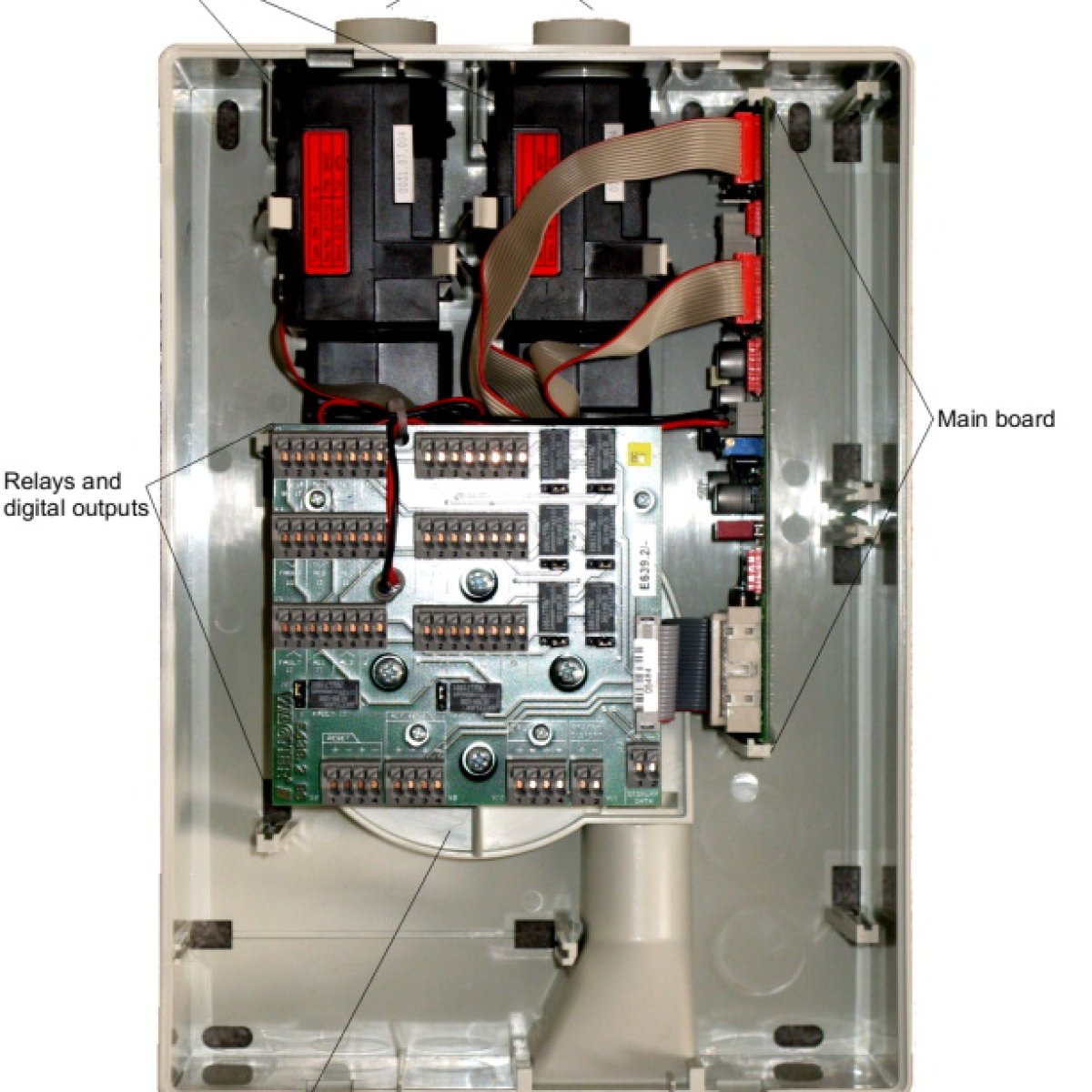
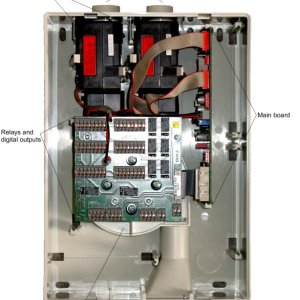
An internal, high-speed fan continuously draws air from the room through these holes, pulling the samples down into the central unit. Before entering the laser chamber, the air passes through a multi-stage dual filter to strip out dense atmospheric dust and fiber debris. The purified air sample then enters a high-intensity laser detection chamber. If even a fraction of a percent of smoke obscuration is registered, the device calculates the precise particle signature and alerts operators well before any visible smoke or heat enters the zone.
Crucial Sensitivity Advantages: Pre-Combustion Warnings
Because ASD systems continuously sample the molecular makeup of the air, their built-in microprocessors can be programmed with up to four distinct, cascading alarm sensitivity stages, providing facility managers with an extensive response window:
1. Alert Stage (0.005% to 0.010% Obscuration/Meter)
The Invisible Threat Indicator: Triggers silently on the network. It registers the microscopic outgassing of an electrical component or wire insulation overheating under load, allowing security teams to inspect the specific server rack before an open flame erupts.
2. Action Stage (0.015% to 0.050% Obscuration/Meter)
Localized Intervention: Automatically alerts the facility's Building Management System (BMS), turning on localized exhaust fans and notifying technical staff via text or panel alerts to cut power to the affected equipment loop.
3. Fire 1 Stage (0.05% to 0.15% Obscuration/Meter)
Building Notification: Sends a verified alarm signal to the primary Fire Alarm Control Panel (FACP), initiating localized strobe alerts and voice evacuation commands throughout the immediate building zone.
4. Fire 2 Stage (0.15% to 2.00% Obscuration/Meter)
Suppression Deployment: Achieves full fire confirmation, triggering localized clean-agent gas suppression networks (such as FM-200 or Novec 1230) to extinguish the localized threat without deploying water.
Key Performance Features
Advanced Particle Discrimination: Uses internal artificial intelligence smoothing algorithms to analyze the laser light scattering profile, accurately differentiating actual fire smoke from heavy airborne dust or humidity spikes to achieve near-zero false alarm rates.
Continuous Pipe Flow Monitoring: Outfitted with high-precision internal ultrasonic flow sensors that constantly track the air volume returning from the sampling pipe loops. If a pipe cracks, gets crushed, or a sampling hole becomes clogged with dust, the unit immediately flags a specific "Low/High Flow Trouble" code.
True Addressable Signaling Line Circuit (SLC) Integration: Connects to the main building fire alarm control panel via a two-wire supervised loop, passing complete real-time obscuration percentages and system health data directly to the central console.
Drastically Reduced Maintenance Overhead: Because the main sampling unit is mounted at eye level on a wall, technicians can perform all routine code testing, filter swaps, and laser calibrations easily from the floor, entirely eliminating the need for expensive high-lift machinery or scaffolding.
Wide Temperature Ingress Tolerance: Capable of operating inside sub-zero environments like automated deep-freeze food facilities by housing the delicate laser unit in a warm external utility room and running sample lines into the cold space.
Ideal Infrastructure Applications
Hyperscale Data Centers & Server Vaults: Positioned directly along return air grilles of CRAC units to sample high-velocity airflows for early hardware failure indications.
Automated Cold Storage Distribution Centers: Where sub-zero temperatures and high racking configurations render traditional point detectors mechanically inoperable.
Clean Rooms & Semiconductor Fabrication Plants: Providing ultra-high sensitivity protection where even a micro-particle breach can wipe out entire silicon wafer runs.
Technical Performance MatrixEngineering Metric ParameterHigh-Capacity Multi-Pipe ASD UnitCompact Single-Pipe ASD UnitSensing Technology CoreHigh-Purity Solid-State Laser DetectionHigh-Purity Solid-State Laser DetectionSampling Pipe EntrancesUp to 4 Separate Pipe Inlet Ports1 Single Pipe Intake PortMaximum Total Linear Pipe LengthUp to 400 Meters ($1,312\text{ ft}$) collective runUp to 50 Meters ($164\text{ ft}$) single runSensitivity Setting Window0.005% to 20.0% Obscuration/Meter (Adjustable)0.02% to 10.0% Obscuration/Meter (Adjustable)Aspirator Fan AssemblyHigh-Torque Multi-Speed Centrifugal FanFixed or Adjustable Compact Fan CoreOperating Input Voltage24V DC Nominal (Range: 18V DC to 30V DC)24V DC Nominal (Range: 18V DC to 30V DC)Internal Output Contact Relays3 to 7 Form C Relays (Fault, Action, Fire 1, Fire 2)3 Form C Relays (Fault, Pre-Alarm, Alarm)Compliance CertificationsUL 268 Listed / FM Approved / EN 54-20 Class A, B, CUL 268 Listed / FM Approved / EN 54-20Standard Procurement Package Components
High-Sensitivity Aspirating Smoke Detector Main Laser Assembly
Pre-installed High-Capacity Primary Filter Elements and Aspirator Fan
Integrated LCD Graphic Status Panel and System Programming Software
Factory Flow Calibration Sheet and UL/FM Assurance Documentation
Required for On-Site Assembly: High-Durability Red CPVC Sampling Pipes, Solvent Cements, Custom Laser-Drilled Sampling Hole Labels, and In-line Water Traps for high-humidity installations (Sold Separately based on fluid-dynamic pipe calculations)